
GTM Teams Are Cutting Stacks From 15 Tools to 5: Inside De-Stacking
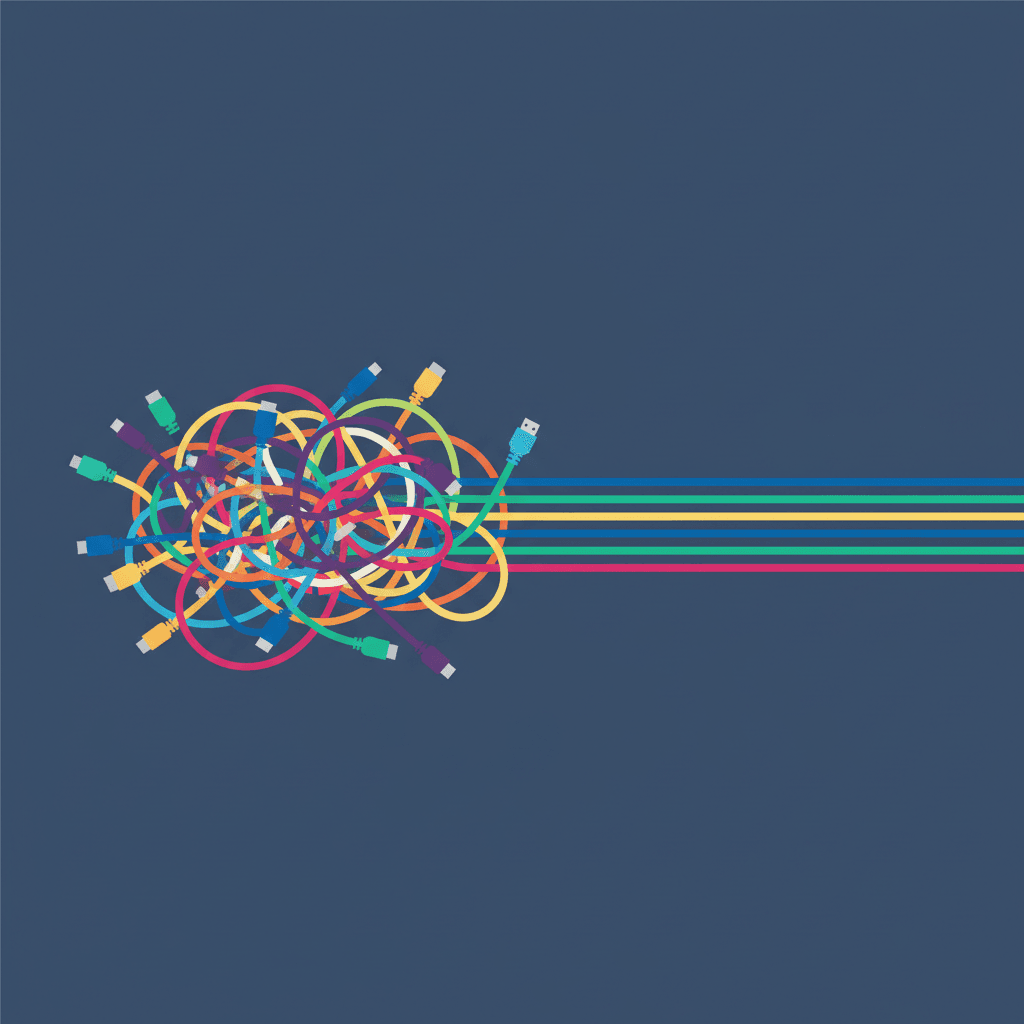
Two months ago, a 14-person agency I work with ran a quiet audit. They counted 17 outbound tools across their client workspaces: Apollo, ZoomInfo, Clay, Smartlead, Instantly, Heyreach, Expandi, Lemlist, Outreach (legacy from one client), three warmup services, two enrichment APIs, a LinkedIn scraper, and a niche intent provider. Monthly burn: $11,400. Active daily users of half those tools: zero.
They're not unusual. Landbase's 2025 GTM stack report and Koncert's recent buyer survey both flagged the same shift — teams that built 10-15 tool stacks during 2022-2024 are now collapsing back to 3-5. The renewal cycle is doing the cutting. RevOps leaders are walking into Q1 2026 with a mandate that wasn't on the table 18 months ago: fewer logos, fewer logins, fewer reconciliations.
This post isn't another "audit your stack in 5 steps" listicle. It's a field report on what's actually surviving the cuts, which point solutions are dying first, and the three stack shapes that GTM operators are rebuilding around — including the LinkedIn+email+enrichment configuration that's quietly becoming the default for agencies and lean sales teams.
Why the consolidation wave is hitting now
Three forces converged. First, the best-of-breed thesis broke under its own weight. Each tool promised 10% lift in its category, but stacking ten of them produced negative compounding — data desync, attribution gaps, and what Forrester calls the "context-switching tax" on reps (estimated at 20-40% of productive selling time across studies).
Second, AI collapsed feature moats. The personalization engine, the deliverability optimizer, the cadence analyzer — these were defensible product categories in 2022. In 2026, they're three prompts and an API call. Vendors that built single-feature businesses around what is now commodity AI are getting absorbed or undercut.
Third, LinkedIn's 360Brew model changed what "good outbound" even means. Volume-based plays got penalized, depth-based plays got rewarded, and the tools optimized for the old paradigm became liabilities. We covered the mechanics in the LinkedIn volume tax piece — the short version is that running 4 separate LinkedIn schedulers across client accounts now actively hurts you.
The Bridge Group's 2024 SDR benchmark put the average sales tech spend per rep at $4,581/year. Teams I've talked to are targeting under $1,800 for 2026 without losing capability. The math only works through consolidation.
The tools getting cut first
Not all categories are equally exposed. Based on renewal data shared by three RevOps leaders and Koncert's buyer intent survey, here's the kill order:
- Standalone email warmup services. Now table-stakes inside sending platforms. Nobody is renewing a separate $99/month warmup tool.
- Single-purpose LinkedIn automators. Especially the ones that can't sync with email sequences. The Heyreach/Smartlead duct-tape stack works, but two logins and a Zapier bridge isn't surviving 2026 budget reviews.
- Niche enrichment APIs. Clay absorbed this category. If you're still paying separately for Hunter, Dropcontact, and Apollo's data API, you're paying three times for overlapping records.
- AI copywriting tools sold as standalone SaaS. Embedded into sequencing platforms or replaced by Claude/GPT API calls.
- Legacy SEPs without LinkedIn-native execution. Outreach and Salesloft are the headline casualties here — more on that below.
What's not getting cut: CRM (Salesforce/HubSpot), conversation intelligence (Gong/Chorus), and contract/CPQ tooling. These have defensible workflow lock-in and clear ROI signal.
The Apollo / Outreach / Salesloft squeeze
The most visible casualty of de-stacking is the classic 2020-era trio: Apollo for data, Outreach or Salesloft for sequencing, plus a separate LinkedIn tool. This stack defined outbound for half a decade. It's losing ground for three specific reasons.
Apollo got hit by the data compliance crackdown and price hikes that pushed agency users to seek alternatives. Outreach and Salesloft, meanwhile, were architected for an outbound world that no longer exists — heavy on email volume, light on LinkedIn-native execution, expensive per seat ($100-180/user/month), and slow to ship against AI-native competitors.
The legacy SEPs aren't bad products. They're priced for a 2019 outbound economy where email volume worked and LinkedIn was an afterthought. Both assumptions are now wrong.
Gong's 2024 outbound data showed reply rates on pure-email sequences declining roughly 30-40% YoY in saturated B2B segments, while multichannel sequences with a LinkedIn touch held steady or grew. When the legacy SEPs require a separate $80/user LinkedIn tool just to be competitive, the per-seat math stops working.
The three stack shapes winning 2026
From watching teams rebuild, three configurations are emerging as the durable winners. Each has a clear identity. None of them includes more than five tools.
Shape 1: The Warehouse-Native Stack (Enterprise / large mid-market)
- Snowflake or BigQuery as the data layer
- Clay or Common Room for orchestration and enrichment
- HubSpot or Salesforce as system of record
- An execution layer (sequencing + LinkedIn) — often LinkedCamp, Amplemarket, or a custom-built layer
- Gong for conversation intelligence
This is the agentic GTM blueprint. Data lives in the warehouse, signals get orchestrated through Clay-style workflows, and execution happens through a thin, swappable surface. Big advantage: vendor lock-in moves from the execution tools to the data layer, where it actually belongs.
Shape 2: The Unified Execution Stack (SMB sales teams, lean RevOps)
- CRM (HubSpot most common)
- Unified outbound platform handling LinkedIn + email + enrichment in one (LinkedCamp, Smartlead+Heyreach combo, or Amplemarket)
- A signal source (LinkedIn Sales Navigator + one intent provider)
- Optional: conversation intelligence
This is the configuration most lean sales teams (5-25 reps) are landing on. The thesis is simple: outbound execution is one workflow, not seven. Splitting it across tools creates more problems than it solves.
Shape 3: The Agency Stack (multi-client outbound shops)
- One multi-workspace outbound platform handling LinkedIn + email + sequencing
- One enrichment/data tool (usually Clay)
- Lightweight project tracking
- Client-side CRM access (read-only)
Agencies have the worst stack-sprawl problem because every client brings their own tools, but they also have the strongest consolidation incentive — they pay for the duplication. The winning agency stacks I've seen are aggressively standardized on one execution platform across all clients, with the agency absorbing the cost as a margin lever.
LinkedCamp runs AI-personalized LinkedIn + email sequences on dedicated IPs, with AI agents that book meetings while you focus on closing.
Why LinkedIn + email + enrichment under one roof is the emerging default
The second and third stack shapes share a defining feature: the outbound execution layer is unified, not assembled. This is where the LinkedCamp-style architecture is quietly winning ground from both legacy SEPs and the duct-taped Heyreach+Smartlead combos.
Three mechanics drive it:
First, identity resolution across channels actually works when the platform owns both surfaces. When LinkedIn and email run in separate tools, you're matching on email-to-LinkedIn URL guesses, and your reply attribution is broken half the time. RAIN Group's research on top performers — hitting 52% conversion in 5 touches — depends on the touches being orchestrated as one sequence, not two parallel streams.
Second, LinkedIn's algorithmic detection punishes the API-bridge approach. Running LinkedIn automation through a separate tool that pipes data into an email platform leaves a detectable footprint. Native execution inside an integrated platform has a cleaner behavioral signature.
Third, the per-seat economics are decisive. The legacy stack — Apollo ($99) + Outreach ($130) + Expandi ($99) + warmup ($49) — runs $377/seat/month. Unified platforms in the $80-150 range deliver equivalent functionality at 40-60% lower cost. Across a 15-rep team, that's $35-50K in annual savings before counting the RevOps overhead saved on integrations.
What this means for your 2026 planning
If you're heading into a renewal cycle, three operating principles are showing up across the teams executing this well:
Don't optimize for feature parity — optimize for workflow parity. A unified tool that does 85% of what your current stack does, with one login and one data model, beats best-of-breed with five logins almost every time. The 15% gap is rarely where your reply rates are actually leaking.
Kill duplicate categories before adding new capability. Most teams running consolidation audits find they're paying twice for enrichment, three times for warmup, and twice for cadence logic. Cut the duplication first; the capability gaps you discover after are usually smaller than expected.
Protect the data layer; rotate the execution layer. CRM, warehouse, and conversation intelligence have real switching costs. Sequencing platforms don't — and treating them like they do is how teams ended up with 15-tool stacks. Pick the execution layer that gives you the cleanest unified workflow today, and accept that you may swap it in 24 months. That's a feature, not a bug.
The teams that ran lean stacks in 2024 looked behind the curve. The teams running lean stacks in 2026 are simply the teams whose reply rates and rep retention numbers are still functioning.
- GTM teams are collapsing 10-15 tool stacks to 3-5, driven by AI commoditization, LinkedIn algorithm shifts, and renewal-cycle budget pressure.
- Standalone warmup, single-purpose LinkedIn automators, niche enrichment APIs, and standalone AI writers are getting cut first. CRM, conversation intelligence, and contract tooling are safe.
- Apollo + Outreach/Salesloft + separate LinkedIn tool — the 2020 default stack — is losing ground because the per-seat math ($300+/rep/month) no longer beats unified alternatives.
- Three winning stack shapes are emerging: warehouse-native (enterprise), unified execution (SMB), and standardized agency stacks. All have a single execution layer for LinkedIn + email + enrichment.
- The strategic move for 2026: protect your data layer, but treat the outbound execution layer as consolidatable and swappable. Workflow parity beats feature parity.
Keep reading

Whitelabel LinkedIn Automation: The 24-Hour Onboarding Stack
The 5-component whitelabel LinkedIn automation stack agencies use to onboard clients in 24 hours — subdomain, sender rotation, unified inbox, reporting, billing.

The Bifurcation: Cold Lists Get 3%, Signals Get 55%
LinkedIn outreach split in two in 2026: cold lists sit at 3-8% reply, signal-triggered campaigns hit 25-55%. Here's why the middle tier collapsed.

Artisan Got Restricted: The AI SDR LinkedIn Reckoning
LinkedIn restricted Artisan's AI SDR in Q1 2026 over data-broker sourcing and trademark misuse. Here's the architecture audit every RevOps leader should run before renewal.
Ready to try LinkedCamp?
14-day free trial, dedicated IP, AI agents — start outbound in under an hour.