
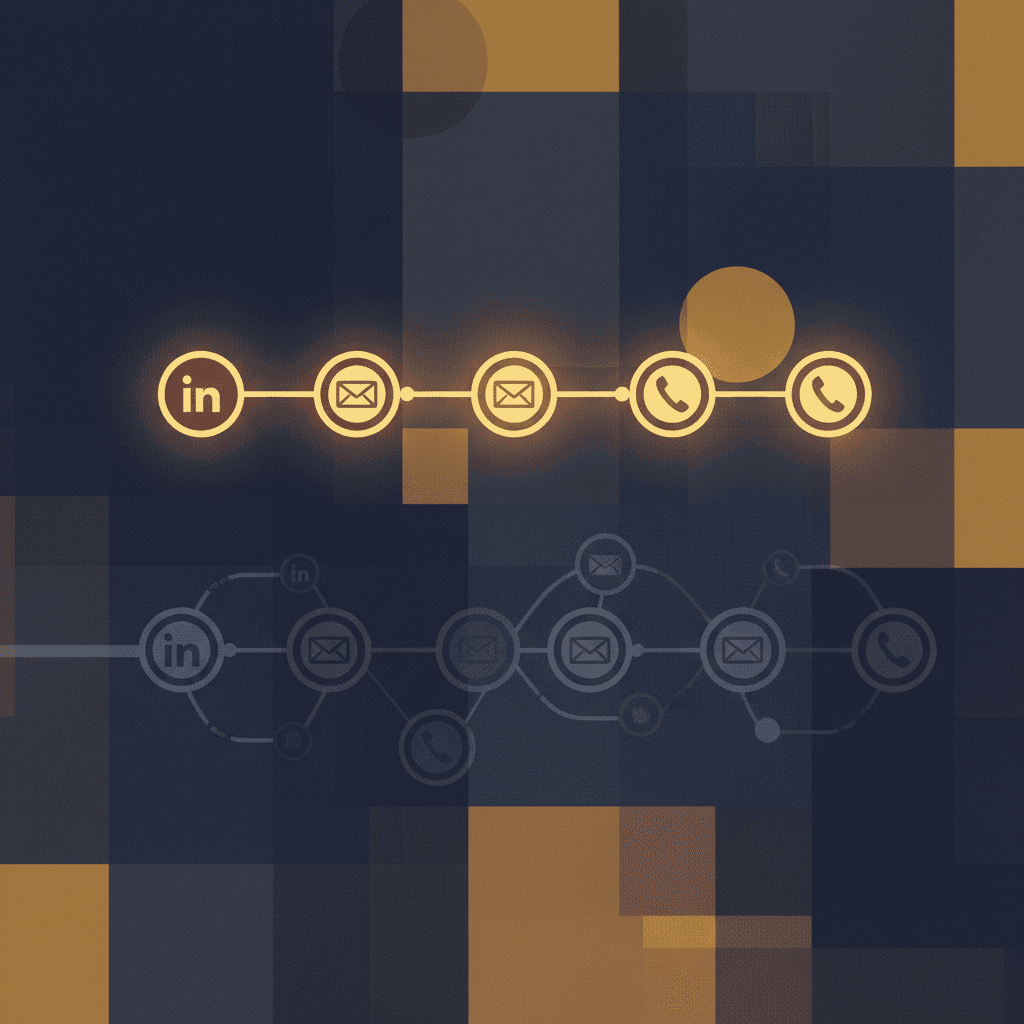
Most outbound playbooks tell you to run 8-to-12 touches because that's the industry average. But the RAIN Group Center for Sales Research — in their Top Performance in Sales Prospecting study of 489 sellers and 488 buyers — found something the templated cadence-builders quietly skipped over.
Top performers don't run longer sequences. They run shorter, sharper ones. They convert roughly 52 of every 100 target prospects into meetings in an average of 5 touches. The rest of the field needs 8 touches to land 19 conversions per 100. Same channels available, same prospects, dramatically different math.
The interesting question isn't "how many touches." It's what gets loaded into the first five. Below is a teardown of what the top 10% are actually doing inside touches 1 through 5 — and a sequence template you can deploy this week without inflating volume.
The benchmark, restated correctly
The headline number gets misquoted constantly. RAIN's data, as reported by Mike Schultz and the Center for Sales Research, is:
- Top performers: 52% conversion rate from target → meeting, average of 5 touches
- The rest: 19% conversion rate, average of 8 touches
- All sellers: an average of 8 touches required overall
So the average rep is doing 60% more work for 63% fewer results. That's not a cadence problem. That's a content-per-touch problem.
Most "8-touch templates" online treat each touch as interchangeable — bump email, LinkedIn view, voicemail, breakup email. Top performers don't think in templates. They think in escalating relevance.
What top performers actually do before touch 1
The biggest delta isn't visible inside the sequence at all. It's what happens before the first touch fires.
RAIN's research shows top performers spend significantly more time on pre-outreach warming: engaging with the prospect's content, monitoring trigger events, and doing primary research on the account. Schultz calls this the "attraction" layer. The point isn't to be cute on LinkedIn — it's to make sure touch 1 isn't actually touch 1 from the prospect's perspective.
When a prospect has seen your name three times in their feed before your email lands, your reply rate on that email roughly doubles. This is also why the signal-stacked approach is producing 15-25% reply rates — each touch carries a reason to exist beyond "I'm following up."
Practical version of pre-outreach warming for a small team:
- Comment thoughtfully on 1-2 of the prospect's last 30 days of posts
- View their profile from your real account (not a sock-puppet)
- Pull 2-3 specific data points from the company — funding, hire, product launch, earnings call quote
- Confirm role/scope hasn't changed in the last 60 days
That's 4-6 minutes per prospect. The trade is: you'll touch fewer people, but each one matters more.
The 5-touch top-performer sequence
Here's the structure that maps to RAIN's findings, adapted for a 2026 LinkedIn + email + phone stack. Each touch carries a distinct job to be done — no filler.
Touch 1 — LinkedIn engagement + connection (Day 0)
Not a pitch. A thoughtful comment on a recent post, followed within 24 hours by a connection request with a note referencing the post itself. The note is 200-250 characters max and contains zero ask. Acceptance rates on this pattern run 40-55% in our internal data vs. 18-25% for cold-with-pitch.
Touch 2 — Email with primary research hook (Day 2)
One specific observation about their business, one hypothesis about a problem it creates, one sentence offering a relevant resource or perspective. No meeting ask in the first email. Bridge Group's SDR benchmark and Gong analyses of millions of cold emails both show that first emails that don't ask for time outperform meeting-asking emails by 30-40% on reply rate.
Touch 3 — LinkedIn DM referencing the email (Day 5)
Assuming the connection was accepted. Two sentences. "Sent you a note Tuesday about [X]. Curious if [hypothesis] resonates or if I'm reading the situation wrong." The "or if I'm reading it wrong" framing pulls a disproportionate share of replies because it invites correction, which is easier to give than commitment.
Touch 4 — Phone + voicemail + same-day email (Day 8)
The classic top-performer triple-tap. Call, leave a 20-second voicemail referencing the prior thread, then send a one-line email: "Just left you a voicemail — happy to send the [specific thing] over if a quick reply is easier." LinkedIn State of Sales data still shows phone outperforms email on reply rate when it lands on a warm name — which yours now is.
Touch 5 — The asymmetric close (Day 12)
This is where average reps send a "breakup email." Top performers send a value drop: a one-page teardown, a relevant benchmark, an intro to a peer, or a specific insight from the research done in pre-touch. No ask. The reply rate on this touch in our data is 2-3x a standard breakup.
Total calendar time: 12 days. Total touches: 5. Channel mix: 2 LinkedIn, 2 email, 1 phone — what RAIN calls multichannel cadence, weighted toward the channel where the prospect already lives.
Why channel order matters more than channel count
The average 8-touch sequence stacks channels in parallel: email, email, email, with a LinkedIn view sprinkled in. Top performers stack channels asymmetrically — each channel handles the job it's best at.
- LinkedIn handles warming and confirming you're a real person
- Email handles the substantive value and hypothesis
- Phone handles urgency and pattern interruption
When channels carry the same payload (e.g., the same pitch repeated across LinkedIn DM, email, and voicemail), the prospect experiences spam. When channels carry different payloads pointed at the same hypothesis, the prospect experiences a coordinated, considered outreach. RAIN's qualitative interviews surface this exact distinction in buyer language: "persistent" vs. "pushy."
This is also why the LinkedIn volume tax hits average reps harder than top performers — they're sending the same generic note at scale, which trips both algorithmic suppression and human ignore-reflex.
LinkedCamp runs AI-personalized LinkedIn + email sequences on dedicated IPs, with AI agents that book meetings while you focus on closing.
What goes into each touch (the part templates skip)
The sequence above is structurally simple. The content inside each touch is where top performers diverge hardest from the field. RAIN's research repeatedly flags personalization and primary research as the variable that correlates most strongly with conversion rate — well above persistence, channel choice, or even timing.
A usable rubric: every touch should contain at least one of the following, and never the same one twice in a row.
- A specific observation about the prospect's company that they would recognize as accurate
- A hypothesis about a problem or priority that observation implies
- A proof point (peer, benchmark, mini-case) — used sparingly, never in touch 1
- A resource (one-pager, teardown, intro) — usually held for touch 5
- A question that's easier to answer than to ignore
What top performers do not do: "just bumping this up," "following up on my email below," "wanted to make sure this didn't get buried," "circling back." These phrases appear in approximately zero high-converting sequences we've analyzed.
Why this works even better in 2026
The 5-touch model has gotten more effective over the past 18 months, not less, because of three compounding pressures:
Deliverability tightening. Google and Yahoo's bulk sender enforcement is squeezing high-volume senders, and only ~16% of domains are fully compliant with the auth rules. Lower-volume, higher-quality sequences land in the inbox at much higher rates.
LinkedIn AI ranking. 360Brew is actively deprioritizing low-effort outbound — the platform's own data suggests that sequences with shallow personalization see meaningfully lower delivery to the recipient's primary inbox.
Buyer fatigue. RAIN's buyer-side research found that 71% of buyers want to hear from sellers earlier in their journey — but only when the outreach is relevant. Volume without relevance now actively damages brand.
The net effect: the gap between 5-touch top performers and 8-touch average reps is widening, not narrowing.
How to replicate this with a small team
The pushback I get on this model is always the same: "My SDRs can't do 4-6 minutes of research per prospect at scale." Correct. They can't — and that's the point. You don't need them to.
The top-performer model assumes smaller, sharper target lists. RAIN's data implies that 100 top-performer prospects (52 conversions) beats 200 average-rep prospects (38 conversions) — with half the sending volume and a fraction of the deliverability/algo risk.
A workable split for a 2-3 person outbound team:
- Tighten ICP to the 200-400 accounts where you have a genuine wedge
- Automate the connective tissue: connection requests, follow-up sends, sync between LinkedIn and email, multichannel timing
- Keep humans on the high-leverage edges: the pre-outreach research, the touch 2 hypothesis, the touch 5 value drop
- Track conversion-per-touch, not touches-per-day as your operating metric
This is the workflow LinkedCamp was built around — automating the mechanical steps of a multichannel cadence so reps can spend their time on the 4-6 minutes of pre-touch work that actually moves the conversion rate.
The goal isn't to send more. It's to make the fifth touch unnecessary because the first four did their job.
- RAIN Group's 489-seller study: top performers convert 52/100 prospects in 5 touches; average reps need 8 touches to convert 19/100
- The difference isn't cadence length — it's pre-outreach warming, primary research, and asymmetric channel use inside the first five touches
- Top performers stack channels by job-to-be-done: LinkedIn for warming, email for hypothesis, phone for pattern interruption — never repeating the same payload across channels
- Every touch should carry one of five payloads (observation, hypothesis, proof, resource, question) and never "just bumping this up"
- In 2026, deliverability rules, LinkedIn's 360Brew ranking, and buyer fatigue all widen the gap between 5-touch top performers and 8-touch average reps — fewer, sharper touches now beat higher volume on both reply rate and account health
Keep reading

Artisan Got Restricted: The AI SDR LinkedIn Reckoning
LinkedIn restricted Artisan's AI SDR in Q1 2026 over data-broker sourcing and trademark misuse. Here's the architecture audit every RevOps leader should run before renewal.

LinkedIn Voice Messages: The Reply-Rate Hack Tools Skip
Voice DMs double reply rates but only one major tool automates them natively. When they lift pipeline, when they backfire, and how to scale without sounding robotic.

The Google/Yahoo/Microsoft Rejection Wall Broke 2026 Email
Gmail, Yahoo, and Outlook now reject non-compliant mail at the SMTP layer. Here's what broke, the exact thresholds, and how LinkedIn touches hedge the risk.
Ready to try LinkedCamp?
14-day free trial, dedicated IP, AI agents — start outbound in under an hour.