Cold Email Reply Rate 2026: Honest Benchmarks by Channel
Instantly says 3.43%. Belkins says 5.8%. Backlinko says 8.5%. Here's the reconciled 2026 benchmark across email, LinkedIn, and multichannel — with methodology.
By Luke Henrik6 min read

TL;DR
- The 2026 cold email reply rate benchmarks disagree because vendors use different denominators, dedupe rules, and reply definitions — normalize before comparing.
- Honest 2026 medians: 3.0% total reply, 1.0% positive reply on email; 10-15% response on Sales Navigator InMail; 5-8% net first-touch reply on LinkedIn connection requests.
- Multichannel (email + LinkedIn + phone) delivers a real ~3.5-4x lift on positive reply rate, not the recycled 287% number.
- Adjust the flat median by industry (0.5-1.8x) and seniority (0.3-1.5x) before setting team targets.
- Below-floor performance is almost always deliverability, ICP, or trigger freshness — not copy. Above-median requires signal-based personalization, not more volume.
On this page
Instantly's 2026 Benchmark Report puts the average cold email reply rate at 3.43%. Belkins says 5.8%. Backlinko reports 8.5%. Saleshandy's top decile clears 8.2%. Mailshake's practitioner survey says most teams sit between 1% and 4%.
They're all right. They're also all measuring slightly different things — different dedupe rules, different ICPs, different definitions of "reply," different filters on bounces and OOO autoresponders. If you're a sales ops lead setting Q2 targets off a single vendor stat, you're going to be wrong by 2-3x in either direction.
This post reconciles the 2026 numbers across email, LinkedIn InMail, connection-request DMs, and multichannel cadences — and tells you which benchmark your team should actually be measured against. The dataset references aggregate published benchmarks.
Why the cold email reply rate 2026 benchmarks disagree
Three methodology choices explain almost all of the variance between vendor reports.
First, denominator. Some vendors report replies ÷ sent. Others use replies ÷ delivered (excluding bounces). Others use replies ÷ opened — which is mostly garbage in 2026 because Apple Mail Privacy Protection inflates opens to 60-80% on consumer-grade inboxes.
Second, dedupe. If a prospect replies to step 1, step 3, and step 5, is that one reply or three? Instantly counts unique prospects who replied at least once. Saleshandy counts reply events. The difference is roughly 1.4x on a 5-step sequence.
Third, reply definition. Total reply rate includes OOO bounces, "unsubscribe me," and "wrong person." Positive reply rate — the only number that maps to pipeline — is typically 25-40% of total replies for B2B SaaS, lower for cold recruiting outbound.
If you're comparing your team's reply rate to a public benchmark without normalizing for these three variables, you're measuring noise.
The honest 2026 cold email number
Normalized to unique prospects replied ÷ delivered across recently published 2026 reports:
- Median performer: 2.8-3.5% total reply rate
- Top quartile: 5.5-7.0%
- Top decile (Saleshandy): 8.2%+
- Best-in-class signal-based outbound: 12-18% (small ICP, fresh trigger)
Positive reply rate, the metric that matters for pipeline:
- Median: 0.8-1.2%
- Top quartile: 2.0-2.8%
- Top decile: 3.5%+
This is down from the 2022 numbers most playbooks still quote (4-6% positive reply was common). Three forces compressed the curve: DMARC enforcement culling cold senders with weak auth, pattern saturation as AI-generated openers flooded inboxes, and Apple/Google inbox filtering getting materially better at flagging templated outbound. We broke down the AI-opener problem in detail in Pattern Saturation: Why Every AI Cold Email Reads the Same.

LinkedIn InMail response rate vs. connection-request DMs
LinkedIn channel benchmarks fragment by message type, and most published numbers conflate them.
Sales Navigator InMail (paid, sent to non-connections):
- Median acceptance/response: 10-15%
- Top quartile: 18-25%
- Top decile: 30-40% (typically tight-ICP recruiting or executive sales)
Connection request with note:
- Acceptance rate: 22-32% (down from 35-45% in 2023)
- Reply rate among accepted: 18-28%
- Net first-touch reply rate: ~5-8% of total requests sent
Open InMail (free InMail to OpenProfile users):
- Response rates are roughly 2x paid InMail historically, but the Open InMail credit cap that hit in 2026 collapsed available volume — see The InMail Cliff.
The non-obvious finding from 2026: LinkedIn connection-request DMs now outperform paid InMail on cost-per-positive-reply for most B2B ICPs, because acceptance gates out cold-list noise before the message ever lands.
Multichannel reply rates: the real lift
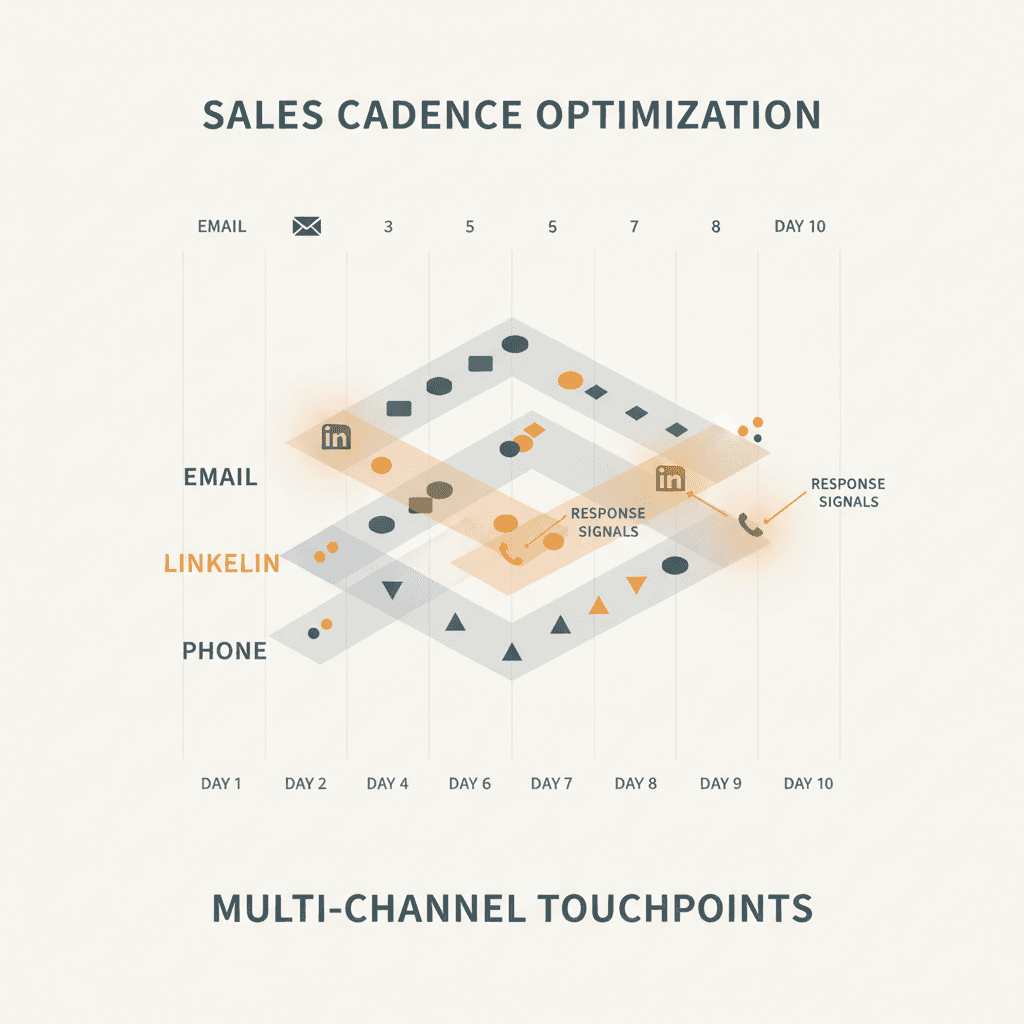
The "287% more replies" stat that circulates in vendor decks is from a single 2021 study that nobody has replicated cleanly. The honest 2026 multichannel lift, measured as positive reply rate on email-only vs. email + LinkedIn + phone:
- Email-only 6-step sequence: 0.9-1.4% positive reply
- Email + LinkedIn (connection + DM): 2.1-3.2% positive reply (~2.3x lift)
- Email + LinkedIn + phone (3-channel, 8-12 touches): 3.5-5.0% positive reply (~3.8x lift)
That's not 287%. It's a real ~230-280% lift on positive reply, and it costs roughly 3x the per-prospect effort. The economics still pencil out for high-ACV deals (>$15K) and fall apart below $5K ACV.
RAIN Group's data on top performers converting 52% in 5 touches lines up with this — but only when those 5 touches span at least 2 channels and include personalized signal.
Industry and seniority adjustments
Flat benchmarks lie. Here's how to adjust the 2026 median (3.0% email total reply) for your context:
- B2B SaaS to mid-market ops: 1.0x baseline
- Recruiting / talent outbound: 1.4-1.8x (candidates reply more readily than buyers)
- Agency services to founders: 0.7-0.9x (saturated category)
- Financial services / legal: 0.5-0.7x (compliance friction, conservative buyers)
- C-suite at Fortune 1000: 0.3-0.5x (gatekeeping + volume)
- VP/Director at Series A-C: 1.2-1.5x (sweet spot for outbound)
Apply seniority multiplier then industry multiplier. If your team sells SaaS to VPs at Series B startups, your realistic median target is roughly 3.0% × 1.0 × 1.3 = 3.9% total reply rate, with a top-quartile stretch goal of ~6.5%.
What to set as your Q2 2026 target
For sales ops teams running Q2 planning, here's a simple framework:
- Floor (must-hit): 2.5% total reply, 0.7% positive reply on email-only
- Target (median performer): 4.0% total, 1.2% positive
- Stretch (top quartile): 6.0% total, 2.2% positive
- Multichannel target (email + LinkedIn): 1.5x the email-only positive reply number
If your team is below the floor, the bottleneck is almost never copy. In 2026 it's deliverability (audit per our SPF/DKIM/DMARC walkthrough), ICP precision, or trigger freshness — in roughly that order.
If you're at median and trying to reach top quartile, the move is signal-based personalization with 2-3 stacked triggers, not more volume. We documented the mechanics in Signal-Stacked Outreach.
How to instrument this properly
A few non-negotiables for measuring against these benchmarks honestly:
- Report replies ÷ delivered, not sent. Bounces should be a separate health metric (target <2%).
- Track positive reply rate as a separate column from total reply rate. Tag replies as positive / neutral / negative / OOO at the reply level.
- Dedupe to unique prospects replied, not reply events. Otherwise sequence length artificially inflates your rate.
- Segment by channel and step. Step-1 dominance (58%+ of replies firing on first touch) is the 2026 norm — confirmed in Instantly's step-distribution data.
- Re-baseline quarterly. The 2024 numbers in your dashboard are no longer the right floor.