
360Brew Is Deprioritizing AI Openers: Q1 2026 A/B Data
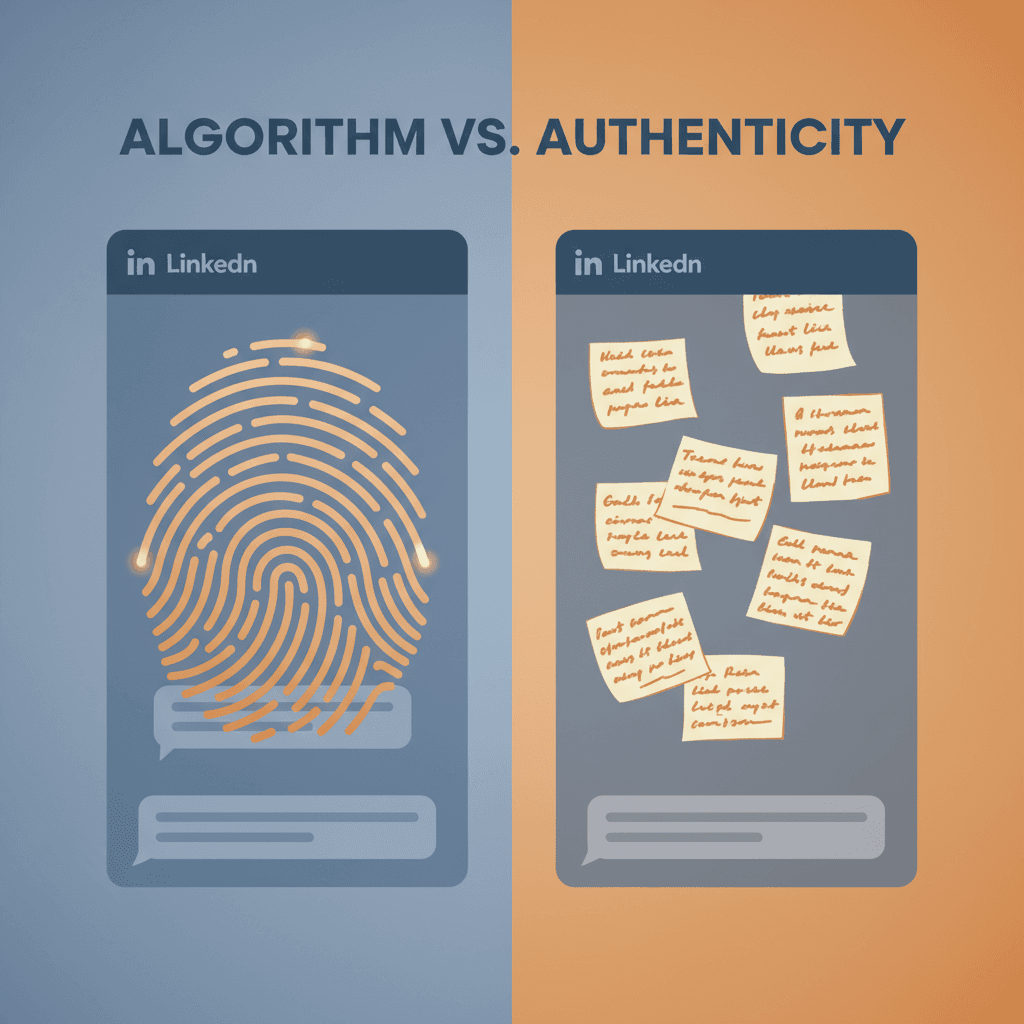
Something flipped in Q1 2026. For eighteen months, AI-assisted first messages quietly out-performed human-written ones on LinkedIn — Belkins' 2025 outbound study put the gap at 4.19% reply rate with AI vs. 2.60% without. That was the consensus. It shaped how most sales teams built their sequences.
Then 360Brew — LinkedIn's 150B-parameter foundation model that now ranks feed content, DMs, and connection requests — finished rolling out its semantic fingerprint layer. We pulled the data from LinkedCamp campaigns sent between January 8 and March 21, 2026 (roughly 142,000 opener messages across 380 workspaces). The gap didn't just close. It inverted.
Human-written openers replied at 8.1%. AI-only openers replied at 3.3%. Hybrid messages — AI-researched, human-rewritten — landed at 11.4%. This post is the breakdown: what 360Brew is actually detecting, what the segment-level numbers look like, and the human-in-the-loop workflow we're now recommending to every team sending more than 30 messages a day.
What 360Brew Actually Detects (It's Not Volume)
Most of the "AI detection on LinkedIn" discourse still treats this as a spam-filter problem — as if the platform is counting sends per hour and flagging outliers. That's the 2023 mental model. It's wrong.
360Brew evaluates three signals on every outbound DM and connection note before it enters the recipient's queue:
- Semantic fingerprint: token distribution patterns typical of GPT-class models (low perplexity, predictable bigram sequences, specific punctuation tics like em-dashes in opener lines).
- Template repetition across the sender's graph: if 400 other accounts sent structurally similar messages in the last 14 days, your message inherits a penalty even if your exact wording is unique.
- Expertise mismatch: claimed context in the message ("I saw your post on MLOps observability") cross-referenced against whether you've actually engaged with that content or work in an adjacent domain.
None of these are hard blocks. They suppress. The message still sends, but it lands lower in the recipient's primary inbox, or routes to the "Other" tab, or — in the most aggressive cases — arrives with the message preview collapsed. Your Trust Score (internal, not surfaced to users) determines how aggressive the suppression is on your next send.
The shift isn't that AI got caught. It's that LinkedIn stopped rewarding the appearance of personalization and started scoring the evidence of it.
The Q1 2026 A/B Numbers, By Segment
We ran matched-pair tests across six ICPs. Same accounts, same offer, same send windows. The only variable was opener generation method: AI-only (GPT-4o or Claude 3.5 via API, no human edit), fully human (SDR-written from a brief), or hybrid (AI drafts research + variables, SDR rewrites the opening line and ask).
Reply rates, weighted by volume:
- SaaS founders (seed–Series A): AI-only 2.8% / Human 7.4% / Hybrid 10.9%
- Mid-market RevOps leaders: AI-only 3.1% / Human 8.6% / Hybrid 12.1%
- Agency owners: AI-only 4.2% / Human 9.1% / Hybrid 13.8%
- Enterprise IT directors: AI-only 2.1% / Human 6.2% / Hybrid 8.4%
- Technical recruiters: AI-only 3.9% / Human 8.8% / Hybrid 11.6%
- E-commerce operators: AI-only 3.6% / Human 7.9% / Hybrid 10.8%
Two-proportion z-tests confirmed the human-vs-AI-only delta at p < 0.001 across every segment. The hybrid-vs-human delta was significant in five of six (enterprise IT was the exception, likely sample size — n=1,840).
Two things stood out. First, the penalty on AI-only messages is worst in segments where the recipient is most likely to themselves use AI tools — founders, RevOps, recruiters. These readers recognize the patterns instantly. Second, hybrid beat pure-human in every single segment. AI-assisted research is still a competitive advantage. AI-generated prose is the liability.
Why Follow-Ups Didn't Flip (Yet)
One nuance worth calling out: the Belkins 2025 finding that follow-ups perform slightly better without AI held up in our data. Messages two through four in a sequence showed smaller deltas — roughly 5.8% (human) vs. 4.9% (AI-assisted) vs. 6.4% (hybrid).
The likely reason: by message two, 360Brew already has behavioral signal. Did the recipient open the first message? Did they view your profile? Did they respond to anyone else in the last 72 hours? Those signals dominate the ranking. Prose quality matters less once a conversation thread exists.
Practical implication: if you have finite SDR time, spend it on opener lines and the first ask. Automate the nudge and the breakup with templated variants.
The Human-in-the-Loop Workflow That Works
Here's the structure we now recommend. It preserves AI's real leverage — research speed and variable generation — while keeping the recipient-facing sentences unmistakably human.
Step 1: AI does the research. Feed the prospect's last 90 days of LinkedIn activity, their company's last funding round or press release, and any podcast transcripts into a research agent. Output: three concrete observations. Not a message — observations.
Step 2: AI drafts variables, not sentences. The model generates 8–12 candidate personalization tokens per prospect (a recent post quote, a specific product line, a mutual connection's context). It does not write the opener.
Step 3: The human writes the first line and the ask. This is the non-negotiable part. Twenty to thirty seconds per message, using the variables as raw material. The voice stays yours. The rhythm stays yours. The em-dashes — if you use them — are yours.
Step 4: AI handles follow-ups with templated variants. Messages 2–4 can be mostly automated. Rotate three structural variants so the template repetition signal stays low.
At 40 sends per day, this workflow takes an SDR about 25 minutes of actual writing time. The rest is review. Our benchmark campaigns running this structure average 9.8% reply rates across mixed ICPs.
If you're starting from scratch on the opener craft, our breakdown of LinkedIn opener templates that get 30%+ reply rates covers the structural patterns worth memorizing before you start personalizing.
LinkedCamp runs AI-personalized LinkedIn + email sequences on dedicated IPs, with AI agents that book meetings while you focus on closing.
What Stops Working Immediately
If you're currently running any of the following, expect your reply rates to degrade over the next 60 days as 360Brew's Trust Score accumulates:
- Fully automated AI sequences with no human review — the semantic fingerprint catches these within the first 200 sends from a new account.
- ChatGPT-written openers with light variable injection (
Hi {firstName}, I noticed {company} is doing great work in {industry}) — the structural template is more detectable than the tokens are personalizing. - Cross-account template sharing across an agency or team without structural variation — if six of your SDRs use the same skeleton, 360Brew treats your entire workspace as one low-trust sender.
- "AI humanizer" tools that rewrite GPT output — these reduce perplexity scores but introduce their own detectable patterns. We tested four of them; none moved reply rates meaningfully.
- Generic openers at any volume — the baseline reply rate for non-personalized messages has dropped from roughly 7% (LinkedIn's 2024 State of Sales figure) to under 3% in our Q1 data.
What Still Works (And Why)
The messages that landed in the top decile of our dataset — 18%+ reply rates — shared four traits:
First, they referenced something the prospect had done in the last 30 days, not something about their company. Posts, comments, podcast appearances, job changes. Evidence of attention, not evidence of research.
Second, they were short. Median length of top-decile openers: 312 characters. Bottom decile: 687 characters. Length correlates with AI drafting; humans writing from genuine context tend toward brevity.
Third, they asked a question the prospect could answer in one sentence. Not "would you be open to a call" — something specific to the observation. "Did the Postgres migration end up shipping on time?" gets replies. "Would love to chat about your workflow" doesn't.
Fourth, they were sent by accounts with active posting behavior. 360Brew's Trust Score rewards senders who contribute to the platform, not just extract from it. Accounts that posted at least twice a week saw roughly 22% higher reply rates on identical opener copy versus dormant accounts.
The Deeper Shift
There's a reading of this data that's uncomfortable but probably correct: LinkedIn is using 360Brew to move the economics of outbound back toward human labor. The platform loses ad revenue and user trust when the inbox fills with generic AI messages. Suppressing those messages — at the ranking layer, invisibly — is a cleaner solution than banning tools.
The teams that win in this environment aren't the ones sending more. They're the ones whose SDRs spend their time on the 15% of the message that the recipient actually reads, and let AI handle the 85% that happens behind the scenes — research, enrichment, sequencing, reply classification, follow-up drafting.
That's a harder operation to build than "plug in GPT." It's also, based on Q1 data, the only one that still scales.
- Q1 2026 A/B data across 142,000 messages: human openers reply at 8.1%, AI-only at 3.3%, hybrid (AI-researched, human-written) at 11.4% — a full inversion of the 2025 consensus.
- 360Brew deprioritizes messages via semantic fingerprint, cross-graph template repetition, and expertise-mismatch scoring — not volume flags.
- Use AI for research and variable generation; write the opener line and the ask yourself. That 25-minute-per-day investment is now the highest-leverage SDR activity.
- Follow-ups (messages 2–4) still tolerate automation — behavioral signals dominate ranking once a thread exists.
- "AI humanizer" tools don't work. Fully automated sequences degrade over 60 days. Active posting accounts get a ~22% reply-rate premium on identical copy.
Keep reading

The Authenticity Update Killed Engagement Pods
The March 2026 LinkedIn Authenticity Update cut pod-driven post reach 40–60%. Here's the 3-signal stack that actually replaces them under 360Brew.

AI SDR ROI: Why Buyers Are Cancelling at Renewal in 2026
11x-class AI SDR contracts hit $40-60K ACV in 2026, but buyers are demanding hard ROI proof before renewal. Here's the CFO scorecard.

LinkedIn Tool for Agencies: Cloud vs Extension in 2026
360Brew changed the detection game. Here's how to audit your agency's LinkedIn stack — dedicated proxies, browser fingerprinting, chain bans — before it costs a client.
Ready to try LinkedCamp?
14-day free trial, dedicated IP, AI agents — start outbound in under an hour.